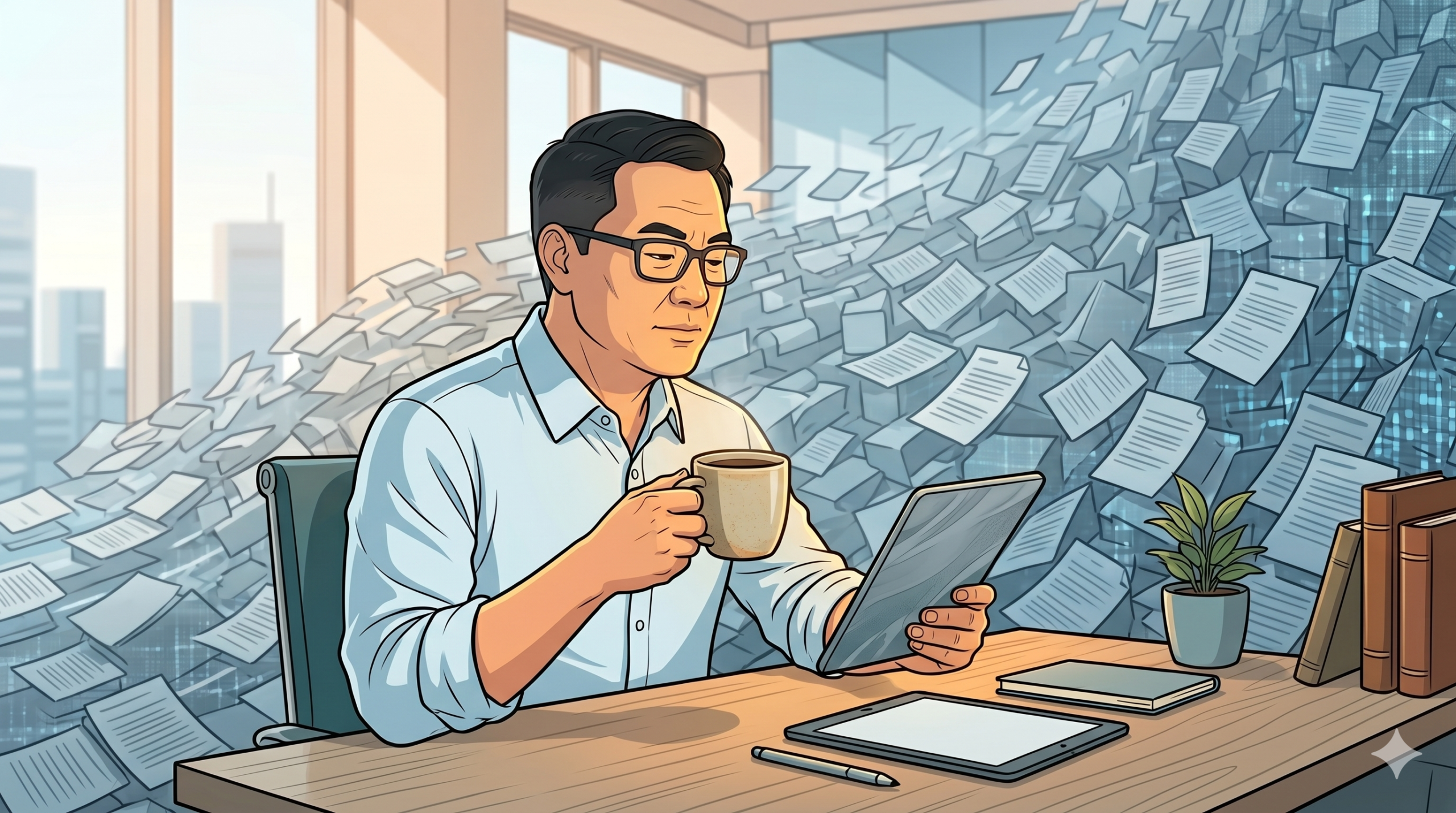
I killed my old Kindle recently.
It stopped holding a charge the way it used to, the way old things quietly stop doing what they were made for before you have quite decided to let them go.
I found someone selling a Gen 11 for a good price and jumped. Set it up on a Friday evening.
And then I did something I had not done properly in longer than I want to admit.
I read.
Not scrolled.
Not skimmed.
Not opened a tab and told myself I would come back to it.
Actually sit, with a big mug of coffee, and read.
Steven Pinker’s The Sense of Style, a book about writing clearly, specifically, and like a human being who has actually seen the thing they are describing.
Made it to the third chapter and some thoughts started flooding my noggin.
Not unusual.
To be honest, I love these intruding thoughts, because they awaken something in me, or I would like to believe they do.
Because it has been too long since I read something written by a person who was fully present in the act of writing it.
Who had a voice that was theirs and no one else’s, or (gasp!) AI’s.
Who had something at stake in the sentences.
I realized, sitting there, that I had been drowning in content, in the endless, competent, frictionless output of an industry that has never produced more and meant less, that I had almost stopped noticing the absence of the thing I actually wanted.
A human being on the page.
Just that.
The Internet Is Full, But I Am Still Hungry.
Somewhere in the last two years, the internet filled up.
Not with people, but with output.
Articles, posts, threads, newsletters, all produced at a volume no human editorial calendar could have sustained just a few years ago. All of it formatted correctly. All of it hitting the right keywords.
And almost none of it making me feel anything.
I do not think this is a coincidence. I think it is a direct consequence of what happens when the cost of producing content drops to almost zero. You get more of it.
A lot more.
And the more of it there is, the harder it becomes to find something worth reading: the thing written by a person who had something at stake.
The Storytelling Advice That Misses the Point
Let me tell you about the last piece of writing that made me stop.
It was not a thought leadership post about the future of marketing.
It was not a five-step framework for anything.
It was not an industry report, a trend analysis, or a listicle about what successful people do before 6am (not that I care, really, as I am still asleep, and I know I can’t do the same!)
It was someone writing about something they got badly wrong.
I do not remember all the details now, but I remember the feeling of reading it. The slight discomfort of recognizing something in it. The way it made me sit up because there’s so much truth in it, even if it’s just a paragraph.
That is what a human being on the page does.
It creates recognition.
The specific, slightly uncomfortable feeling of seeing your own experience reflected back at you by someone who had the honesty to put theirs down in writing.
No AI model produces that.
Not yet, and possibly never ever, in the way that matters.
I’ll always remember my Lit teacher at Secondary 4 reminding us that human stories matter while we read Ngũgĩ wa Thiong’o’s The River Between, a book that has impacted me greatly.
Because the stories that actually do something to you are not the ones that were constructed to.
They are the ones where someone sat down and wrote the true version of something that happened to them, including the parts that do not resolve neatly, where they come off badly, or even that have no lesson attached.
Why Specificity Is More Human Than Any Framework
The stories that stay with you are not universal.
They are particular.
They are not about overcoming adversity in general.
They are about the specific Tuesday when a specific thing went wrong in a specific way that the person had not anticipated, and what they thought about on the MRT home afterwards, and how they told their spouse about it or did not, and what they ordered for dinner that night because they did not feel like cooking.
The particular is what creates recognition.
Not the universal.
This sounds counterintuitive. You would think the broader the experience, the more people would relate to it.
But it works the other way.
The more specific the detail, the more a reader feels that the writer has told the truth.
And the more they feel the truth has been told, the more they find themselves in it.
I grew up in Singapore. I have worked in construction sites, in data centres, in air-conditioned offices where the gap between the screen and the equatorial heat outside felt like a different kind of distance than just geography.
None of that is universal.
All of it is mine.
And the writing I have done that has meant the most to other people has been the writing that leaned into the specific rather than reaching for the general.
The Version of the Story Nobody Actually Posts
LinkedIn has a particular aesthetic of resilience.
Everything is a lesson. Every setback contains a seed. Every failure is retrospectively the best thing that ever happened to the person writing about it, because here they are on the other side, wiser and more successful, generously sharing the insight for the benefit of their network.
I do not blame people for this. The platform rewards it. The algorithm rewards it.
Be honest: we have collectively trained each other to produce it.
But it is (sometimes) exhausting to read.
And it is, honestly, oftentimes exhausting to write because you are always working backwards from the resolution. You are always tidying up the experience before you present it. You are always making yourself the protagonist of a story that has already been edited for easy consumption.
What I want to read, and what I suspect you also want to read, if you are honest about it, is the version before the edits.
The one where the protagonist gave in to something they knew they should not have. Where they said the wrong thing and knew it immediately but said it anyway. Where they chose comfort over courage and lived with that for longer than they expected. Where they are still, at the time of writing, in the middle of something they cannot yet resolve.
That is not weakness.
That is being a person, an imperfect human being, as we all are, and in a feed full of output, it is the rarest thing there is.
What (I Believe) Being Human on the Page Actually Requires
Oh, no, no, no, before you jump to conclusions, I am not saying produce confessional content for its own sake, or that every post needs to be a therapy session that nobody signed up for.
I am saying that the single most valuable thing one can do as a writer (or aspiring writer) right now, when the volume of competent, well-formatted, utterly forgettable content has never been higher, is to be a real human being on the page.
Not a thought leader. Not a personal brand. Not a content creator executing a strategy.
But a person who has failed at something, wanted something they did not get, got something they did not expect, and has enough honesty and enough craft to write about it in a way that lets someone else feel less alone in their own version of the same experience.
That is not a content strategy.
It is harder than a content strategy.
It requires you to write the true account of things, which is more uncomfortable than the optimized version.
It requires you to leave wounds open that you would rather patch up.
It requires you to trust that the specific detail that feels too small, or too particular, or even just too embarrassingly personal to include, is often the exact detail that makes the piece worth reading.
Being Human Is the Most Countercultural Thing You Can Do Right Now
AI is not going away.
I use it daily, and I will keep using it.
I think it is genuinely useful, but useful is not the same as human.
And in a world where useful content is now essentially free and infinitely scalable, the thing that cannot be replicated, the thing that has actual scarcity value, is the specific texture of a life that only one person has lived.
Yours.
Write from there.
Not from the lesson you extracted from it. Not from the framework you built around it. From the experience itself, in all its particular, unresolved, occasionally quirky and even embarrassing detail.
That is what I think people are hungry for, or at least will in time come to crave.
That is what makes someone stop scrolling.
That is the most countercultural thing a writer can do right now.
Be a person on the page.
Just that.
Nothing more complicated.