
There is a particular kind of workplace language that sounds like honesty but is doing something else entirely.
Hungrier.
That was the word Lee Shuling used on a ChannelNewsAsia (CNA) podcast recently. Lee is a 42-year-old ex-lawyer running a legal recruitment firm. The clip made its rounds through Instagram, LinkedIn, and Reddit, and by the time it finished its run, she had been called arrogant, out of touch, and, in one widely shared comment, made up like “a corpse in a coffin.”
That last comment is an ad hominem attack so, no, I do not agree with it.
I would rather disagree with her with facts and with what I have learned from speaking to foreigners who have come to Singapore to work.
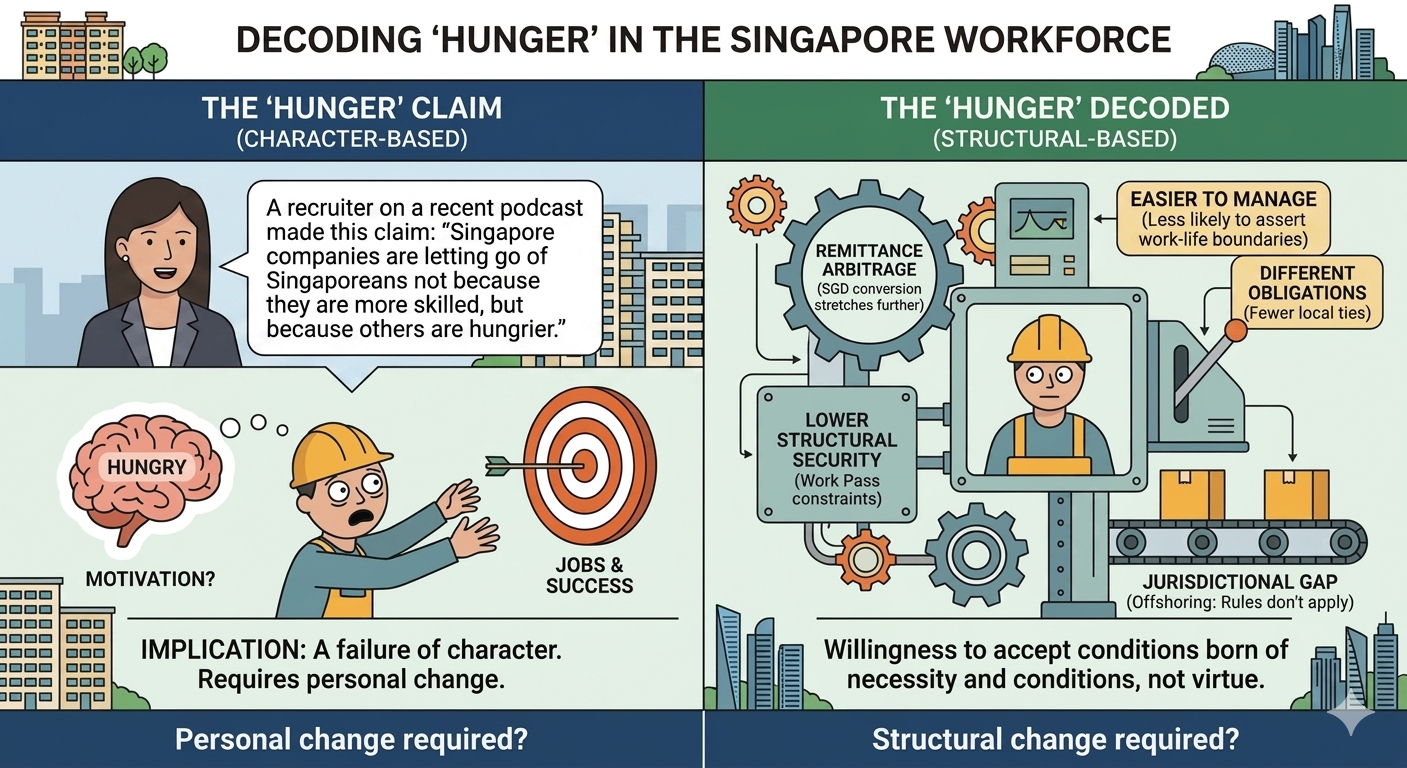
Here is the claim that caused the detonation: the companies she works with are letting go of Singaporeans in favor of hiring people from Malaysia, Vietnam, and the Philippines, not because they are more skilled, but because they are hungrier.
A Reddit thread on r/SingaporeRaw picked it up, and the usual arguments followed. Some agreed with her. Some pushed back hard. But underneath the noise, there is a question worth sitting with: what does “not hungry enough” actually mean when applied to Singaporean workers, and who benefits from the framing?
When “Not Hungry Enough” Is Not a Neutral Observation
“Hungry” is not a neutral observation. It is a moral frame that implies those who are not hungry are therefore sated, comfortable, indifferent. It treats desire for work as a character trait that some people simply possess and others, Singaporeans in this case, do not.
Lee‘s comment was not describing a skills gap, a certification deficit, or a sector mismatch. It was describing motivation, or rather, the absence of it, and attaching that absence to Singaporeans as a group.
I have been job hunting this year for B2B marketing roles in cybersecurity and enterprise tech across Singapore, so I know what it feels like to have someone assess your hunger before they have bothered to ask what you are actually after.
I am therefore not approaching this as an academic exercise.
What “Hungry” Is Actually Measuring
When someone says a foreign worker is hungrier than a local, what they are often actually describing is this: a person who relocated from another country to work here has, by definition, accepted conditions that a local resident would be less inclined to accept.
They may be earning in SGD and remitting the bulk of it home in a currency where it stretches further. They may not have family obligations locally. They may be on a work pass that gives them far less structural security than a citizen or PR, which means they cannot afford to say no, to push back, or to go home at a reasonable hour.
One commenter in the thread put it plainly: Hungry = despo and exploitable.
That is blunt, but it is not wrong to a degree.
The recruiter was not identifying a failure of character. She was identifying a willingness, born of necessity rather than virtue, to accept conditions that a person with roots, rights, and a local cost of living would rationally decline.
The Comparison That Was Never Fair
Years before I was in marketing, I was a Project Manager at a construction firm. I had a team that included several Indian workers on S Passes, men who had the experience and qualifications to serve as site supervisors.
During downtime or over meals, I would ask them why they had come all the way here to work. The answers were remarkably consistent. They wanted to buy land back home. To build houses for their families, with some even aiming to build a house per household. That was the primary goal, and everything else was in service of it.
I remember sitting with that. Here was a man earning just about S$3,000 a month, and he was going to use it to buy land and build a house. Here I was, on a considerably higher salary, almost double his, and the most I was stretching toward was a 3-room HDB flat.
Does that make him hungrier than me? By some definitions, probably yes.
But the honest framing is not about character. He had an arbitrage that I did not have. Three thousand dollars in Singapore, converted and sent home, could do something in India that the same sum could never do here. He was not more motivated than me in any deep sense. He had a structural advantage that made the sacrifice of leaving home worth it in a way it would never be worth it for me to leave Singapore.
You are not comparing the average Singaporean to the average foreigner. You are comparing the average Singaporean to a self-selected group: people who had enough drive, savings, or desperation to leave their home country entirely. That cohort is not representative of the broader population they came from. They passed a filter that the average local professional never needed to pass, because the average local professional never needed to leave.
“Not hungry enough” is describing a structural condition as if it were a personality trait. The distinction matters because the solution to a personality trait is personal change, while the solution to a structural condition is structural change.
Misidentify the problem and you keep applying the wrong fix.
What “Hunger” Is Actually Asking For
What exactly is being demanded of the hungry Singaporean worker?
One commenter in the thread ran through the list with an exhausted sarcasm I found more incisive than most of the earnest analysis.
Be hungrier than foreigners who do not say no to overtime. Be hungrier than foreigners who do not say no to being contactable on weekends. Go the extra mile. Upskill on your own time. Network inside and outside your field. Accept that asking for more money makes you greedy. Want marriage and children but do not let that affect your availability. Have babies for the national good. Oh, and consider working as a hawker or a plumber rather than chasing degrees.
The list is incoherent, but that incoherence is the point. The demands are not consistent because they were never really about building a better workforce.
They are about having workers who are easier to manage and less likely to assert that they have lives outside the office.
I have sat in meetings where the language of passion and ownership was used to explain why someone was working twelve-hour days without additional compensation. I have heard managers describe employees who left on time as not being team players.
What is being asked for, when a recruiter says hungrier, is more often compliance dressed in the language of character.
The Question the Noise Drowned Out
Bertha Henson, a former journalist, addressed this in a Facebook post that cut through much of the online heat.
Her argument was not that Lee Shuling chose her words well. She did not, and her Instagram follow-up daring critics to “do something about it” rather than be offended made the tonal problem worse.
But Henson’s point was that the substantive question had been almost entirely lost in the outrage.
Whether the underlying claim is even true. And if it is, whether the frameworks we have built actually address it.
Here is what the frameworks say. Under the Fair Consideration Framework, every Employment Pass and S Pass application must be advertised on MyCareersFuture for at least 14 consecutive days before a foreign hire can proceed, with locals fairly considered.
The Workplace Fairness Act, passed in January 2025, hardens this into law with penalties attached. At the lower-skilled tier, dependency ratio ceilings cap the share of foreign Work Permit and S Pass holders against the local workforce.
For Employment Pass (EP) holders, the PMET tier Lee was most likely referring to, there is no such hard cap.
The controls are a salary floor and COMPASS, a points-based framework that scores firms on the diversity and local share of their PMET workforce.
These are not nothing, but as Henson rightly noted, it is genuinely hard to hold an employer accountable who, at the interview stage, picks the foreigner because he seemed hungrier, then dresses the decision up in fit-and-merit language by the time the paperwork reaches the Ministry of Manpower (MoM).
The choice has already been made before any regulator sees it.
The bigger gap is jurisdictional. None of these rules reaches a job that has already left. If a Singapore firm closes a role here and opens one in Manila, no work pass is issued, no MyCareersFuture ad is required, and no Singapore statute applies.
The displaced Singaporean shows up in the retrenchment data. The Manila hire never appears in any MOM dataset at all.
PMET retrenchment incidence rose to 10.1 per 1,000 resident PMETs in 2025, up from 8.6 in 2024. MOM describes this as ongoing restructuring and skills transition. The less charitable reading is that ongoing restructuring is exactly what regional offshoring looks like in the data: roles disappear here, hiring continues there, and the headline numbers never quite break.
That is the conversation Lee’s word choice prevented us from having.
What I Actually Think
I think the “not hungry enough” framing is lazy.
It serves employers more than it serves anyone trying to understand what is actually happening in the Singapore labor market. It lets companies off the hook for hiring practices and workplace conditions that produce exactly the kind of disengagement they are now blaming on local character.
There is also something real underneath it.
Not hunger.
Something more like the accumulated weight of being told, consistently, that your job is to be cheaper, more compliant, and more available, and the resulting decision, made individually and then collectively, to invest your actual self somewhere other than the office.
That is not a character defect. It is a rational response to what the market has asked of people over a long period of time.
The recruiter made a claim about individuals. About their drive, their character, their hunger. But the more useful question is what structures produce the outcomes we are seeing.
If Singaporean workers are, on average, less willing to work the hours and accept the conditions that some foreign workers accept, is that a failure of motivation? Or is it a rational response to having rights, roots, and costs of living that the wage on offer does not cover?
If companies consistently prefer candidates who will not push back or go home, is that because those candidates are better workers? Or because they are easier to manage?
If the answer to both questions is uncomfortable, that discomfort is precisely why the phrase “not hungry enough” is so useful to the people who use it. It keeps us arguing about character when the real argument is about conditions.