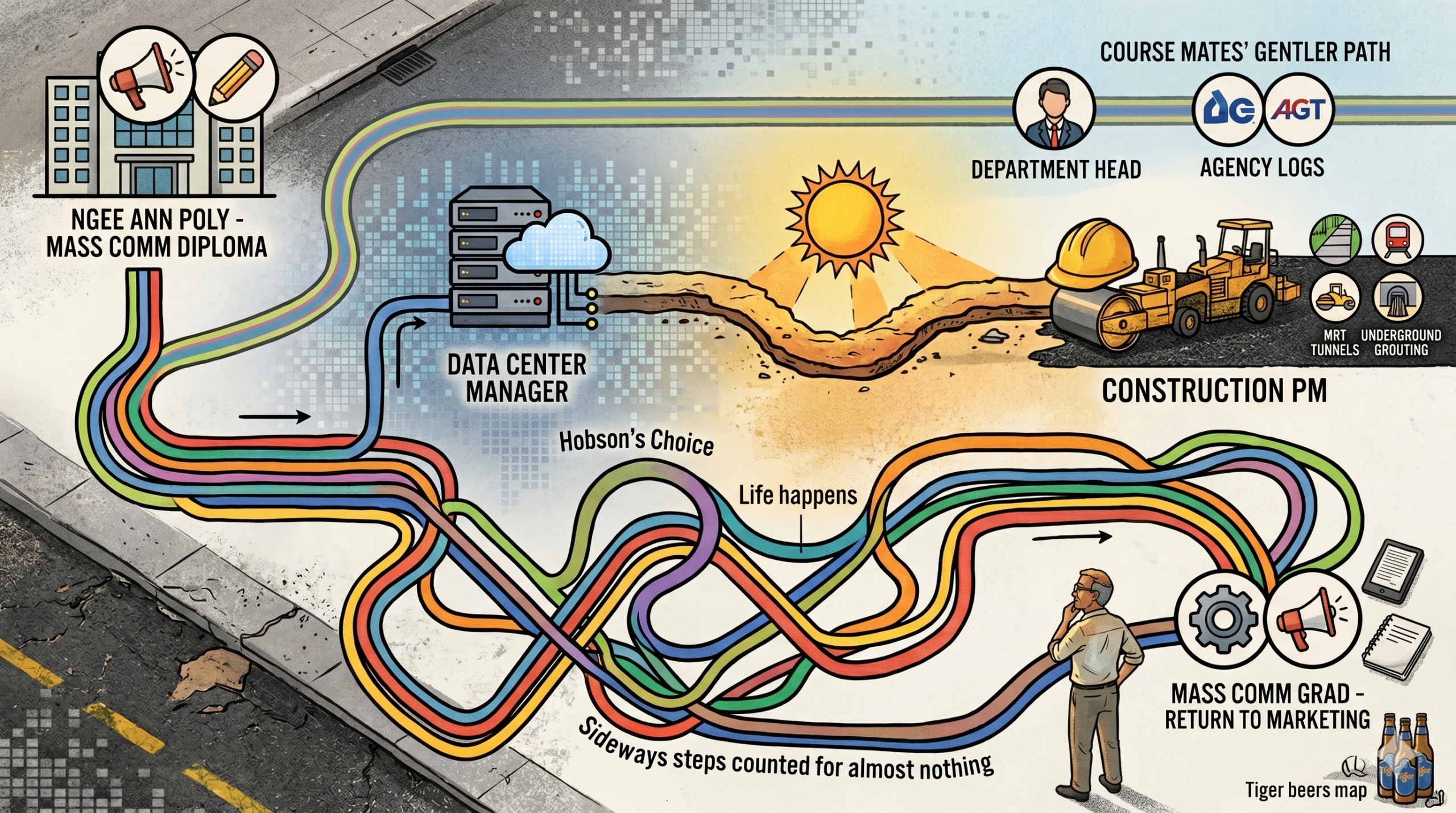
I graduated with a Diploma in Mass Communication from Ngee Ann Polytechnic. Then I spent years doing everything but. Now I am back, older and considerably more sunburnt, trying to figure out where AI fits into a career that never quite followed the plan. This is where I think out loud.
From Data Centers to Sunburns
Many don’t know this, but I was a construction Project Manager for close to a decade after losing my job as a Data Center Manager with one of Singapore’s Internet darlings during the dot com bubble “bloop”.
Talk about a career pivot, but it was Hobson’s choice, really.
Newly-married and with a new HDB (public housing in Singapore) to pay for, it made total sense when an ex-colleague approached me to help him with his new business.
He saw a video on YouTube showcasing a protective layer on asphalt, saw the opportunity, and managed to convince the inventor and owner of the company to market and apply the material on local pavements here.
The early days were tough.
Not only was it back-breaking work for someone was more used to sitting hours before a screen in an air-conditioned office than sweating buckets under the merciless equatorial sun, the pay was measly.
That, and the environment.
Older folks who have been in the construction industry here may attest to this: back then, bosses and superiors in this industry don’t give two hoots about shouting at you and putting you down.
Sort of like being a recruit (me) in the Armed Forces in the late 1980s.
And, yes, even in front of customers.
Thankfully, an associate I knew then recommended me to another company doing the same, but with a Korean product, and after a good chat with the boss, who was also Korean, I jumped ship.
Honestly, the work was fine. I have even gotten used to the merciless sun, but the toxic environment was bad.
I left after five years at the second company, having decided that I’ve had enough sun.
Wide, Not Deep
And for the first time in years, I had to ask myself a question I had been too busy, too tired, and too sunburnt to sit with: what now?
The honest answer was that I should have been asking it much sooner.
See, before the data centers and before the asphalt, I studied Mass Communication at Ngee Ann Polytechnic. That was the plan. Media. Marketing. Communications. The whole lot.
And for a while after graduation, that was the path I was on.
Then the dot com bubble went “bloop,” and life did what life does.
When I look at some of my course mates from Ngee Ann today, the ones who stayed in PR, who stayed in marketing, who kept their heads down and climbed, I would be lying if I said there was no sting.
Some of them are heading departments today. Some are running agencies. They had the luxury of a straight line, or at least a line that only curved gently.
Mine looks more like an MRT map someone drew after three Tiger beers.
I carried that for a long time. The sense that every vertical switch was a step sideways while everyone else was stepping up. Data center manager. Construction project manager. Back to marketing.
As a newcomer, akin to a fresh graduate starting from a position where I had to prove myself all over again, where my years of experience in one field counted for almost nothing on paper in the next.
But here is what I have come to terms with, slowly and not without some stubbornness: those years were not wasted. They were just very hard to explain on a resume.
A decade in construction taught me how to manage people who did not want to be managed, how to deliver on a timeline that weather and suppliers and sheer human stubbornness conspired against daily, and how to hold my ground when someone twice my seniority was screaming in my face in front of a client.
You do not learn that in a marketing textbook.
The data center years taught me systems thinking. How infrastructure works. How technology serves (or fails) people. How a single point of failure can cascade into something ugly if nobody is paying attention.
And Mass Comm gave me the thing that tied it all together, even when I could not see it: the instinct to communicate.
To frame a message.
To understand an audience.
That muscle never atrophied, even when I was not using it professionally. It was there every time I wrote a proposal for a tender, every time I had to explain a technical failure to a non-technical client, every time I had to convince a skeptical boss that there was a better way to do something.
So when I finally circled back to marketing, it was actually not a fresh start.
It was a return.
Sure, it was a late one, but I came back carrying things my course mates who stayed the course never had to pick up.
The problem, and I am still wrestling with this, is how you put all of that on a piece of paper. How do you look at a hiring manager and say: I know my resume reads like I could not make up my mind and ended up everywhere but nowhere, but every single one of these detours gave me something I can use today?
There is no neat LinkedIn headline for “Mass Comm grad who managed a data center, paved roads and waterproofed underground car parks, did grouting in MRT tunnels, and found his way back.”
Which, funnily enough, is part of how I ended up here.
With AI.
Next week: I tell you what actually happened when I started poking around with AI, why it was people building things rather than headlines about job cuts that really got me, and what a Mass Comm grad with a construction tan and a data center brain thinks he can actually do with it. Follow me here so you do not miss it.